




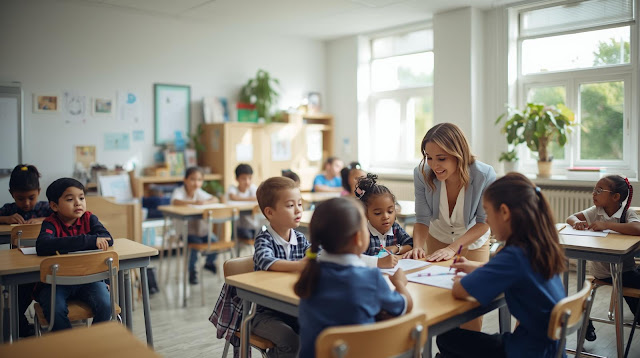
In every kindergarten classroom, there are moments when teaching feels like a balancing act. On one side, there are academic goals, lesson plans, and learning outcomes. On the other, there are children with diverse needs—some needing more support with behavior, emotions, or social skills.
When multiple students require additional attention, it’s easy to feel stretched thin. The question becomes:
How can we support individual children deeply, without losing the rhythm and wellbeing of the whole class?
This reflection is not about perfection. It’s about clarity, priorities, and practical systems that make teaching sustainable.
🧭 1. Start With What Matters Most: Safety and Belonging
Before academics, before performance, the foundation of any classroom is:
- Safety (physical and emotional)
- Belonging (feeling accepted and valued)
If a child feels unsafe or targeted, learning slows down—for everyone.
If a child struggles to regulate behavior, it is often not defiance, but a lag in skills such as:
- impulse control
- emotional regulation
- social understanding
These are commonly associated with traits seen in Attention Deficit Hyperactivity Disorder, but regardless of labels, the classroom response remains the same:
👉 Teach the skills, not just the rules.
⚖️ 2. Redefining Fairness in the Classroom
Fair does not mean equal.
Some children need:
- more reminders
- more structure
- more emotional support
Others need:
- more challenge
- more independence
A balanced classroom is not one where every child gets the same—but where every child gets what they need to succeed.
⏳ 3. Managing Time Without Losing Yourself
One of the biggest challenges is time.
It is not realistic—or sustainable—to give constant attention to one child while managing an entire class.
Instead of asking:
❌ “How can I give more time?”
Shift to:
✅ “How can I design systems that reduce the need for constant intervention?”
🛠️ 4. Practical Systems That Make a Difference
🔹 A. Structure Reduces Behavior Problems
Children thrive when they know what to expect.
- Clear routines
- Visual schedules
- Simple, repeated instructions
When structure increases, disruptions decrease.
🔹 B. Attention Is Powerful—Use It Wisely
Children often repeat behaviors that get attention.
If most attention goes to correcting:
👉 Negative behaviors increase
If attention is given to positive actions:
👉 Positive behaviors grow
A simple shift:
- Notice effort
- Praise small successes
- Acknowledge improvement immediately
🔹 C. Teach Behavior Like You Teach Academics
We teach:
- how to read
- how to count
But children also need to learn:
- how to wait
- how to take turns
- how to respond to frustration
These should be:
- modeled
- practiced
- revisited regularly
🔹 D. Use Preventive Teaching, Not Just Reaction
Before transitions or group activities:
- Remind expectations
- Ask children to repeat them
- Model the correct behavior
Prevention is always more effective than correction.
🔹 E. Create Independent Engagement
To free up time for support:
- Use station learning
- Offer choice within structure
- Prepare meaningful, simple tasks
When students are engaged, fewer conflicts arise.
🤝 5. Building a Supportive Classroom Culture
A classroom is not just a group of individuals—it is a community.
Without guidance, children may:
- blame others
- label peers
- exclude those who are different
This must be actively taught and shaped.
🔸 A. Normalize Mistakes
Children need to hear:
- “Mistakes are part of learning”
- “We help each other improve”
🔸 B. Replace Blame With Support
Instead of:
- “He is bad”
Guide students toward:
- “How can we help our friend?”
🔸 C. Teach Kindness as a Skill
Kindness is not automatic. It must be practiced through:
- role-play
- daily language
- teacher modeling
🔸 D. Build a Shared Identity
Simple daily messages matter:
- “We are a team”
- “We help each other”
Over time, this shapes how children see one another.
🧩 6. Supporting Individual Needs Without Overload
When multiple children need support, the goal is not to do more—but to do smarter.
Focus on:
- Consistency over intensity
- Small, repeated actions over big interventions
Examples:
- one clear expectation at a time
- one replacement behavior taught clearly
- one success celebrated immediately
👩🏫 7. Working as a Teaching Team
If you have an assistant teacher, alignment is essential.
- Use the same language
- Reinforce the same expectations
- Share observations regularly
Consistency between adults creates stability for children.
🌿 8. Protecting Your Energy
You cannot pour from an empty cup.
It is okay to:
- not solve everything in one day
- prioritize what matters most
- accept gradual progress
Teaching is not about fixing every challenge instantly.
It is about building systems that support growth over time.
🌟 Final Reflection
A well-balanced classroom is not one without challenges.
It is one where:
- children feel safe
- differences are supported
- learning continues despite difficulties
When we shift from:
👉 controlling behavior
to
👉 teaching skills and building community
We create an environment where every child—not just one—can grow.
This journey takes patience, consistency, and reflection.
But over time, small intentional changes lead to meaningful transformation—for both students and teachers.